MEGAN BOXALL – running Britain’s entire coastline – Runner’s World, Sept 2026 issue
For 10-year-old Megan Boxall, the 2003 end of year prizegiving at school was a proud day. It was an occasion to honour the most talented and studious pupils at her private girls’ school, Royal Masonic in Rickmansworth, and her uncle was to be the guest of honour, making the speech and handing out the prizes.
Tom Isaacs, the younger brother of Megan’s mother Caroline, had been in the news in April of that year, having completed a year-long walk around the British coastline. Diagnosed with Parkinson’s disease in 1995, aged only 27, his walk raised enough money for him to co-found a new charity, Cure Parkinson’s, which is still funding important research today.
He managed to hang on to a sense of humour despite the cruel hand dealt to him. He began his walk on the Millennium Footbridge in London because when it was first built it was nicknamed the ‘Wobbly Bridge’. He walked with a stick which he called ‘Eric’. Later he wrote a book about the adventure which he titled Shake Well Before Use. ‘He said it was because he felt like his life didn’t have any purpose until he got Parkinson’s,’ says Caroline today. ‘He was shaken up, and then he was useful.’
Tom walked from London to Southend-on-Sea on the east coast of Essex, turned left and kept going, only making a sad pause at the northeast corner of Scotland when he learned that his father had died from a heart attack. After the funeral he resumed walking, finishing the lap just in time for his 35th birthday. In his later years he would be invited to be a London Olympics torchbearer and to meet Pope Francis in Rome, before dying in 2017, aged 49. Newspaper obituaries proclaimed him a remarkable fighter for people living with Parkinson’s. The actor Michael J Fox, who has his own Parkinson’s foundation, also paid tribute: ‘Tom’s passion, determination and hard work on behalf of everyone living with Parkinson’s were the hallmark of his life and will be his continuing legacy in our community,’ he said.
An extraordinary man, but one whose outsized life might feel slightly more normal if he was a member of your immediate family. ‘I knew it was a big thing to do, obviously, but it was also just what he did,’ says Megan about her uncle’s walk. ‘It never felt like something that was out of reach for me, because he had already done it.’
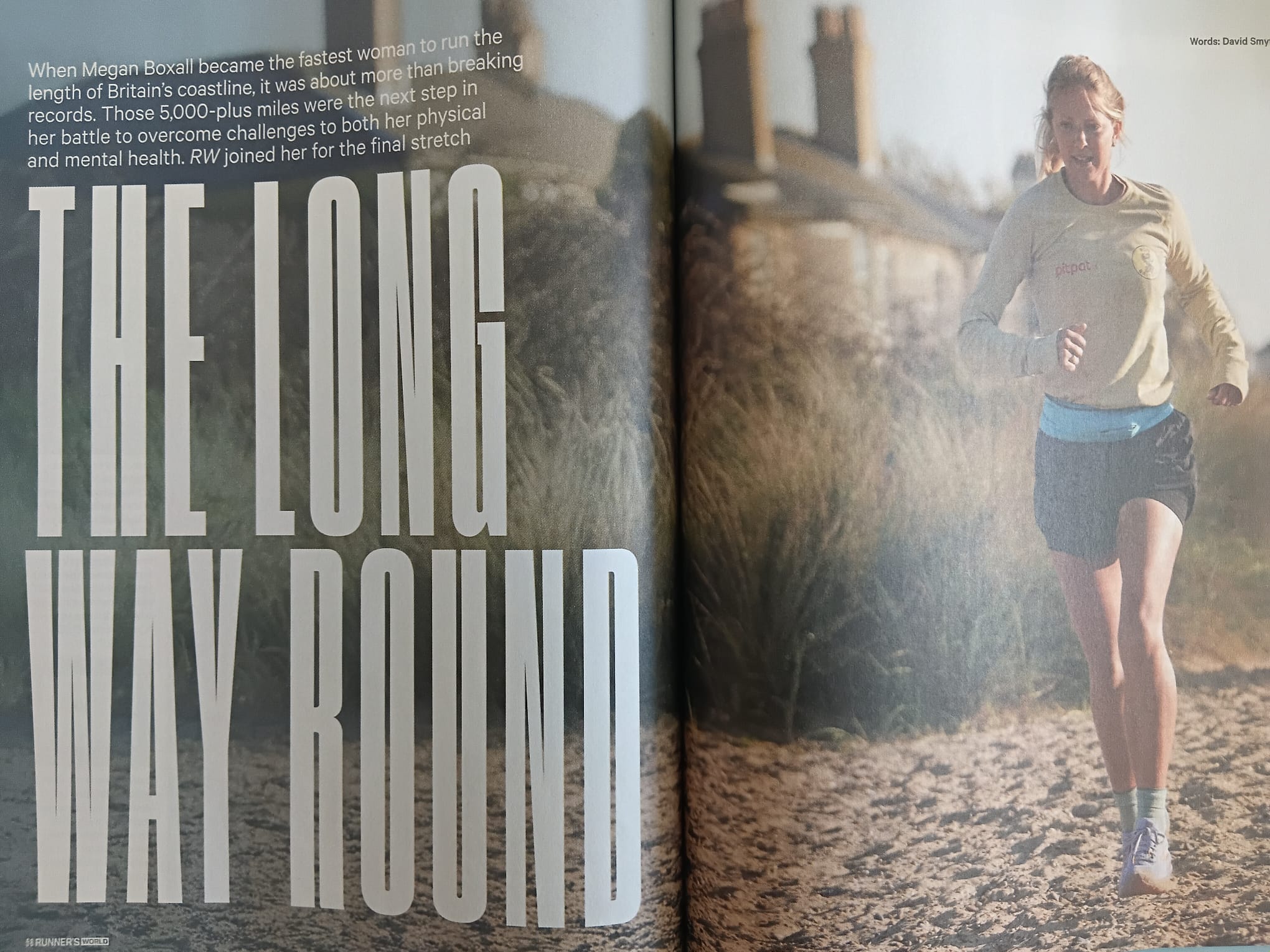
Aged 33, slightly younger than her uncle was, on 9 May this year Megan completed her own full lap of the British coastline.She went in the opposite direction, starting on Sizewell beach in Suffolk on 18 October 2025 and going clockwise, and instead of walking, she ran. To conceptualise it neatly, she planned to do 200 marathons in 200 days, which amounts to 5,240 miles. In reality it took 204 days and somewhere a bit over 5,000 miles – which is close enough.
They say it takes a village to raise a child. It also takes a village to complete a solo endurance running challenge. In this case, the village is Thorpeness, halfway between the towns of Lowestoft and Felixstowe on the Suffolk coast. First developed in the early 1900s as an exclusive holiday resort with a country club, golf course and boating lake with its own annual regatta, Megan’s family, based in Hertfordshire, has spent summers in the area since her grandmother was a child. Her grandparents bought a house there about 30 years ago. Megan, her mother, three younger sisters and youngest brother would spend entire school summer breaks there while dad Chris came up from work on the weekends, building friendships with other holidaying families that are still firm today. Lottie Riggs, a fellow Thorpeness summer veteran, was the linchpin of the Run Britain endeavour. When she wasn’t driving a campervan across Scotland she was having long supportive phone conversations with Megan every day during the runs. Numerous other local family friends came out to support her or run with her at the start and finish nearby.
The rest of Megan’s metaphorical village spreads more widely: uni friends, companions from the running community, generous strangers who heeded her call on social media and provided beds for the night in parts of Britain far from home. A sponsor, PitPat, who make GPS trackers for your dog’s collar that double as a kind of doggie activity Strava. Megan’s collie, Shadow, wears one. Shadow is possibly the supporter who helped most of all. She’s the one who brought Megan back to life.
Like uncle Tom, Megan had a powerful personal reason to keep going along the British coast. During 2024, she needed to call the mental health charity the Samaritans five times. On two of those occasions the empathetic listening of the volunteer on the phone helped her to retreat from an imminent attempt to take her own life. She had to spend some time in critical psychiatric care. ‘I didn’t see how my life could get any better, and I didn’t want to keep living, as sad as I was,’ she says now.
She’s wary of naming solid things that could take the blame for her catastrophic mental state. She doesn’t want anyone to read about her and think they shouldn’t be feeling so low themselves because their problems are less ‘serious’ on paper than hers. ‘I have a strong idea of what contributed to the real depression, but I also know that I was heading that way anyway,’ she says. ‘It doesn’t have to be something major in your life that sets you off like that. Maybe it never got as bad before, but I don’t think I’d felt like myself for 20 years.’
She thinks that during 2023 she never went more than two days without crying. She was drinking too much, spending too much and working too hard as a financial journalist for a private investment portal called Stockopedia. In the summer of 2023 she lost vision in one of her eyes for about six weeks – a serious issue, but nevertheless her optician just told her to come back in six months if it hadn’t got better. It did get better, but became worse again in January 2024. This time the optician asked her which of the letters on the chart she could see and she said: ‘I can’t even see you.’
After an MRI scan she was diagnosed with Relapse-Remitting Multiple Sclerosis, the most common variant of the lifelong neurological condition, which means she can be without symptoms for long periods and then suffer from flare-ups that could manifest in any number of ways. On the day she was diagnosed, she lost all feeling in her hands and feet for the next six weeks. Her mother Caroline, a children’s author and educator, also has MS. She was diagnosed later in life but in hindsight, was experiencing symptoms from about Megan’s age.
Around the same time as this life-changing news, Megan separated from her husband and they began the divorce process. She eventually had to move out of the flat they owned in Hertford. She has stayed more quiet about this when talking to all the podcasters, radio and TV hosts about what brought her to the Run Britain start line – perhaps it makes the story less neat than ‘health crisis, big run, hurrah’ – but life isn’t neat. It’s too simplistic to blame depression on one cause and nor would it be correct for us to claim here that running has fixed everything.
‘Mental illness is not a case of: something bad happens, you’re really sad. For me it was probably years of suppressing myself and my personality. Yes, there were some triggers that led to complete inability to cope, but in some ways I’m quite grateful that those things did happen, because I needed to walk away from the life that I was in before. I wish it hadn’t happened in the way it did, but I absolutely needed to.’
After leaving Hertford, she moved in with the dog.Shadow was adopted at four months by her parents from a Dogs Trust shelter in late 2023, a year after the beloved family border collie Nelly had died. She was disobedient – in fact, the day Megan met her for the first time she ran away for several days – but when Megan became ill, Shadow barely left her side.
Megan moved into the Thorpeness house alone, and her concerned parents asked her to take Shadow too. ‘She was a reason for me to stay alive. I had to take care of her,’ Megan says. She had already been named by the shelter, at a guess after the Enid Blyton book Shadow the Sheep-Dog, but it turns out she is obsessed with her own shadow. She watches it intently in the sunshine, as though it is about to dash off by itself and require chasing.
Megan has always been a runner, among other sporting endeavours. She got a degree in Sports Science from Bath University. By 2023 she had built up to doing a marathon in Porto and a half Ironman in Weymouth in quick succession. It was while running on the beach with Shadow in early 2025 that she first felt the weight of her depression briefly lift, and began to think about what she might do next. Why not attempt her own version of her uncle’s feat, and try to raise money for the charity that had helped her?
She searched online for others who had run around Britain and came across Nick Butter. The Dorset athlete is better known for doing something even more ridiculous: a marathon in every country in the world between 2018 and 2019. In 2021 he also ran anti-clockwise around the British coast, starting and finishing at the Eden Project in Cornwall. He was aiming to do it in 100 days but injury meant he completed the challenge in 128.
These days he has his own holiday company offering guided daily runs, Run Weekends. Megan booked to go on one of his trips to the Lake District in early 2025 so that she could meet him and pick his brains. ‘You could have just emailed me,’ he said.
‘I’m so glad I went, though, because that weekend honestly changed my life,’ says Megan. ‘I had decided to run around the coastline of Britain and thought it would probably take me a year. He’s the one who said: “Why not do 200 marathons in 200 days?” and because he’s such an inspiring person, I was like: “Yeah! Sure!”’
She handed in her notice at work the day after she got back from the Lake District. ‘I’d never met anyone whose attitude was just: “Do it! Go for it!” I wanted to go all in, like he had when he ran the world. I was willing to quit my job and spend all my savings. My life as it was before had ended, and I had literally wanted it to end. I can see now that there’s something kind of refreshing about a genuine rock bottom. I never want to be there again, because it was absolutely awful, but it has made me become myself. I don’t need anything I had before. I can just be me.’
After that: a period of website building, route planning and spreadsheet logistics. Lots of people ask her why she decided to start in October, and it does seem unwise to have spent the winter in northern Scotland, including running during four named storms. The closest she came to needing to cut the challenge short was in January, when she learned that six homes had to be demolished in Thorpeness after storm damage and became concerned for her own seafront home.
However, when she cruised to the finish line next to the giant golf ball of Sizewell B power station on 9 May, sunshine blazed and it looked like she’d timed the whole thing perfectly. I met her in person the day before, after she’d completed the penultimate run and finished up amid the genteel beach huts of Southwold. That day she learned that her fundraising target of £50,000 for the Samaritans had finally been passed, right on time.
With nut brown skin and sun-bleached hair, she looked like she was just back from a fortnight in Ibiza. She arrived at a pub garden with an entourage worthy of a rapper: camera and marketing people from the sponsors; Heather, a uni friend and crewing companion who wasn’t into running before but has now signed up to do the Malaga Marathon with Megan in November; Lottie, the run co-organiser and serious F1 fan who continues to have no intention of taking up running; and Sam King, a fellow ultrarunner who only met Megan a few months earlier and jumped with both feet into helping her. A number of other friends and family members popped in and out while Shadow dozed under the table.
Sam has his own inspiring running story and has been featured in RW in his own right. At one time officially the best in the world at playing the video game Call of Duty, with the lack of physical fitness that implies, between September and December last year he completed 79 ultramarathons: 50k a day mostly around his home town of Frinton-on-Sea, setting a new world record and raising many thousands for the brain injury charity Headway UK. His mum suffered a brain bleed at the start of 2025. Megan thinks they may even have run past each other on the Essex coast, when she was on day three of her challenge and he was on something like day 25, but they didn’t know each other then. She reached out to him after he’d finished, to ask for some social media tips: how had he managed to create Instagram posts that ended up being shared so widely? He helped with her content, but also ended up travelling to Scotland to drive her van for a fortnight, and running over 300 miles with her.
Megan nursed a beer and nibbled some chicken wings while she tried to recall being in the same part of the country 203 days earlier, starting her loop of the nation by doing the same parkrun that she would finish with the next morning. It was pretty chaotic. They were late. Shadow, who isn’t a parkrun fan, was so busy playing with her sister Beth’s dog Lilah that the humans lost them. Eventually, after being cheered off by wellwishers and BBC Look East, she was on her way towards Bawdsey Bay in the company of her other two sisters, Emily and Katie. Youngest sibling Charlie was content to be the fastest Boxall at the parkrun and left the next 5,000 miles to big sis.
She eased her way into a new routine: up around 5.30am for blogging and social media duties, porridge with oat milk, out running by 7.30 or 8. Something like a half marathon til a stop for lunch, then the rest of the marathon distance, or more if accommodation logistics and energy levels allowed. She relied on friends, acquaintances and Premier Inns for beds until Scotland, when she used a campervan.
Near the beginning she had a few wobbles. Sandwich to Folkestone, day 14, was the day it started to get hilly. It was raining, she was on her own, and she sat on a bench in Dover and cried. A young man sat down beside her and asked what was wrong: ‘I’m running around the coastline of Britain and it’s really hard,’ she replied. By day 17, shin splints did their worst. She spent three days walking between Bexhill and Worthing, including Beachy Head and the demanding rollercoaster of the Seven Sisters cliffs. Day 20 was her first full day of rest, and she had to carry on walking the rest of Sussex after that.
Eventually, though, her body became accustomed to what it had to do. Later there were big highs, including the glorious scenery of the coastal paths in Devon, Cornwall and Wales. She delighted in living in a campervan, being able to forget about packing and unpacking every day. The north coast of Scotland was over too quickly. She loved running over the Forth Bridge towards Edinburgh so much that she went back and did it again.
After the fun of Scotland, Yorkshire was the last tough patch. ‘I had a really difficult week. I was back on my own, unsupported, staying in different people’s homes every night which was really generous and lovely but they were all strangers,’ she says. ‘My hip had started hurting, I wanted to be with people who I knew, I wanted to see Shadow and it was so hard.’
A side effect of raising awareness about mental health: not only do you have to talk to new people about your darkest days more often than you might like, but they tend to want to tell you about theirs too. ‘Because I have been open about why I’m doing this, people are very willing to be open with me about their own difficulties. It means I can end up feeling like I’m bearing quite a big load. By the time I got to Hull, my head was down completely.’
With 192 days of the run complete, Megan phoned the Samaritans one more time. Once again, they helped. ‘I was terrified of finishing,’ she says. ‘I did a lot of press stuff in Yorkshire and every single person was asking me: “So what’s next?” I was absolutely terrified about what would come next. This is what got me out of the hole in the first place, so when it’s over, will I be back in the hole? I’m very confident now that I won’t be, but I did feel that.’
The last day started early: 6.30am by the cannons of Southwold’s Gun Hill, in order to cover the last 10 miles down the coast, pop some prosecco and still be on time for a 9am parkrun victory lap. The homecoming armada consisted of sisters Beth and Emily, Beth’s imminent husband Ryan, Sam, uni friends Amber and Max, Thorpeness friend Toby, two dogs and me, trying not to be undeservedly prominent in the photos.
A local runner emerged from the dunes, looking to join the fun after following Megan’s run online. Then a pack of middle-aged men on mountain bikes arrived for a quick congratulatory interrogation. There was finishing tape, of course. Banners saying ‘Welcome home Strava final boss!’ and ‘204 days, 200 marathons, 1 incredible woman’. The group faded to the sides to allow Megan and Shadow to take the hard earned glory. The journey complete, the fastest woman to run around Britain cried.
‘When we were about 2k away I was starting to panic that I wasn’t feeling how I was supposed to feel,’ she confesses afterwards. ‘But then as soon as I crossed the line, I felt exactly how I was supposed to, which was incredibly emotional.’
Some obvious questions, but they’re an important part of processing something huge: has Run Britain been what she expected it to be? ‘It’s been so much… I don’t know what the word is… so much fuller than I dreamed it would be,’ she says. And how is she different from the person who did this same parkrun (significantly more slowly) 204 days earlier? ‘I feel a lot calmer. Obviously I did lots of planning and preparation, but things went wrong or were different to how I expected them to be, and I just went with it. I’ve learned just to appreciate the moment as I’m in it, rather than worrying.’
I tried not to ask the dreaded ‘What’s next?’ question. Imagine being wheeled semi-conscious out of a hospital delivery suite and being asked what your plans are for your next baby. A couple of things came up anyway during the time we spent together. There was talk of the Camino de Santiago trail, and definite plans to try to break the record for the fastest marathon by a woman with MS. That will require a significant PB, but after months of 180-mile weeks, she’s now a completely different runner.
‘Doing this has shown me what a difference it can make to people who are struggling. I want to keep trying to pursue that, to keep trying to help and support people. I don’t yet know what that looks like, but I’m not scared that I don’t know.’
It sounds like a future. And when you’ve been doing something for so long that it’s become who you are, become the reason you keep going every day, who says you have to stop and do the next thing? On 20 May, less than a fortnight after Megan’s challenge was completed, she stepped outside, turned right at the sea, and ran a marathon.
Instagram: @megan.runbritain
Donate at justgiving.com/page/megan-boxall-run-britain
You can reach the Samaritans by phoning 116 123 day or night or emailing jo@samaritans.org. More info at samaritans.org